
The subsidy will be credited to bank accounts of farmers against cane price dues and are compliant with WTO norms. This will benefit millions of farmers in Uttar Pradesh, Maharashtra and Karnataka.

The central government is on track to meet its fiscal deficit target of 6.4 per cent of the GDP for 2022-23 on the back of strong growth in revenue collections, the World Bank said in its India Development Update on Tuesday. High nominal GDP growth in the first quarter supported strong growth in revenue collection, especially Goods and Services Tax (GST), despite tax cuts on fuel. Notwithstanding an increase in spending due to expanded fertilizer subsidies and food subsidies for vulnerable households in response to the commodity price shock, the government is on track to meet its FY22/23 fiscal deficit target of 6.4 per cent of GDP and the general government deficit is projected to decline to 9.6 per cent from 10.3 per cent in FY21/22 and 13.3 per cent in FY20/21.

'There are occasions when the prices of individual items like food raise inflation; then supply-side measures must be taken.' 'But if there is continued inflation, it means liquidity is aggravating the situation.'
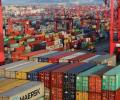
The GST Council on Saturday is expected to extend the date for IGST exemption and cess on imports

Buoyed by an increase in public investment and incentives to boost manufacturing, India's economy is expected to grow by 8.3 per cent in the fiscal year 2021-22, less than the previous projection early this year before the country was hit by the second wave of the COVID-19 pandemic, the World Bank has said in its latest report. World Bank chief economist for the South Asia Region Hans Timmer told PTI here that when one looks at the high frequency data, they see that as a result of the second wave of the COVID-19 pandemic, the recovery paused, and some indicate that the recovery actually declined briefly. "We project for this fiscal year 8.3 per cent (growth rate for Indian economy) that is less than we projected early in the year before the health crisis caused by the second wave. "Given the sharp contraction of the economy last year, it might not look like a lot, but in my view, that is actually very positive news, given the violent second wave and the severity of the health crisis," he said on Thursday.

Imports in July 2012 were 65 tonnes, said a bullion analyst.

The finance minister, in her Budget speech, should focus more on what she is directly responsible for, rather than on programmes where her role is largely supportive, notes Nitin Desai.

To mobilise private capital in the clean energy sector, the US has agreed to place a field investment officer in India apart from hosting a series of events to overcome strategic barriers in accelerating institutional and private financing.

Exporters can make payment of fees through debit/credit cards.

The current account deficit widened to $10.1 billion or 2.1 per cent of GDP for the September quarter as against 1.2 per cent in the year-ago period.
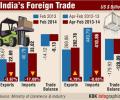
For the April-February period, exports were up 4.79 per cent to $282.7 billion, according to data released by the Ministry of Commerce and Industry on Tuesday.

Lower gold imports and higher overall exports to help narrow the gap.


India's appetite for imported crude oil may wane in fiscal year (FY) 2023 from record levels in pre-pandemic 2019-20 fiscal as higher oil prices, a spillover from the conflict in Ukraine, and increasing use of biofuels affect domestic demand for petroleum products. Brent crude surged to a nine-year high, shy of a July 2008 record $147.50 a barrel, before declining to around $100 a barrel - but the volatility in commodity rates will slow global economic growth and use of fuels. Demand for all oil products may grow at only 2-3 per cent in FY23, slower than the current fiscal and nearly half the 5.5 per cent growth estimated by the petroleum ministry, according to industry officials.

March was the worst month for gold imports because of a strike by jewellers over the imposition of an excise duty.
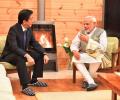
During Abe's tenure, Japan had announced support for a number of major projects. These included the bullet train project between Mumbai and Ahmedabad, besides allocations for a freight corridor between Mumbai and New Delhi.

India and the US on Monday committed to further improving bilateral ties, exploring alternate mechanisms for funding renewable energy and actively pursuing the G20 agenda which includes strengthening MDBs and taking coordinated action to deal with climate change. Several issues, including climate action, rising indebtedness in low and middle income countries and digital public infrastructure, figured during a bilateral meeting between Finance Minister Nirmala Sitharaman and US Treasury Secretary Janet Yellen held on the sidelines of the G20 meeting of Finance Ministers and Central Bank Governors. India, Sitharaman said, will "look forward to furthering ... bilateral interests through development cooperation and new investment opportunities through Alternate Investment platforms for renewable energy."

India will need to travel back in time and seek inspiration from football greats Tulsidas Balaram and Chuni Goswami to deftly dribble around and sidestep the West-imposed price cap on exports of Russian seaborne crude oil. India depends on imported oil to meet 86 per cent of its needs, of which nearly a quarter now comes from Russia. The copious flows are roughly 10 per cent cheaper than competing suppliers helping India save billions of dollars in fuel costs.

The external environment has worsened further. While the Finnish economy entered into a recession, Swedish economic growth also dipped. The Finnish gross domestic product (GDP) dropped 0.6 per cent in October-December, 2022. It was the second quarter of negative growth, which is a technical definition of recession.

The four officials were asked questions related to the UPA government's '20:80' gold import scheme, which was cleared by Chidambaram on May 13, 2014, barely three days before the counting of votes of the general election

Prime Minister Narendra Modi Wednesday said the International Monetary Fund (IMF) sees India as a "bright spot" in the global economy and as per the World Bank, India is in a better position to deal with the global headwinds than many other countries. This is because of India's strong "macroeconomic fundamentals", Modi said while virtually addressing the inaugural function of the 7th edition of Invest Madhya Pradesh-Global Investors Summit in Indore. In the past eight years, the government has increased the speed of reforms and removed many hurdles in the way of investments.
India's economic growth will be above 6 per cent in the current fiscal as the country has managed to strengthen its macroeconomic stability and performance even in a period of large global shocks, RBI Monetary Policy Committee (MPC) Member Ashima Goyal said on Monday. Goyal further said that a global slowdown reducing India's export growth, geopolitics fueling oil and food prices, and erratic weather are some of the continuing risks that the country faces. "India has managed to strengthen its macroeconomic stability and performance even in a period of large global shocks.

All the global transitions are working in India's favour, giving it the potential to become a force in today's uncertain world, but one of the country's biggest challenges is inclusive growth, Tata Sons chairman N Chandrasekaran said on Monday. In his address at the JRD Tata Oration, the head of the Tata group also asserted that Artificial Intelligence (AI) is here to stay and it will be beneficial if India prepares for it. Post the cold war era of relative stability and prosperity, the world appears to have given way to unpredictable conflicts and economic uncertainty, he said, adding that the pandemic resulted in supply chain shocks of gigantic proportion.

Rating agency Fitch on upgraded outlook of 10 financial institutionals, including SBI, ICICI Bank and EXIM Bank of India to 'stable' from 'negative' earlier following revision in the country's outlook.

At 12-15 tonnes, the imports in September are estimated to be much lower than in the same month last year.

India's economic growth is now 'extremely fragile' and needs all the support that it can get, as private consumption and capital investment are yet to pick up, RBI Monetary Policy Committee (MPC) member Jayanth R Varma said on Friday. Varma further said out of the four engines of growth for the economy, exports and government spending supported the Indian economy through the pandemic, but other engines need to pick up the baton now. " I like to think in terms of the four engines of growth for the economy: exports, government spending, capital investment and private consumption. "...while exports cannot be the main driver of growth because of the global slowdown, government spending is necessarily limited by fiscal constraints," he told PTI.

The Reserve Bank of India also banned with immediate effect issuance of letters of comfort which, like LoUs, are used by importers to fund their overseas purchases.

Gold imports tick up 10.47% to $2.42 billion in May.

India's exports remained in the negative territory for the 11th month in a row.

Experts hail Obama's India trip as a big step towards signing of imp trade agreements.

The Reserve Bank of India (RBI) has liberalised the procedure for facilitating the import of rough diamonds (termed roughs in the trade).

Finance Minister Nirmala Sitharaman on Tuesday said many countries have evinced interest for bilateral trade in the rupee after the RBI announced a mechanism recently. Speaking at Mindmine Summit 2022, she said this along with other steps taken by the government is towards full capital account convertibility. "It isn't the rouble-rupee which was in the old format. "Now this (bilateral rupee trade) formulation, which I am glad the RBI has come up at a time which was so critical," she said when asked if India is ready for capital account convertibility.

Echoing similar views, CII too said the Prime Minister has given high importance to manufacturing and investment.
No prior approvals required for setting up off site ATMs will enable banks speed up their franchise expansion.
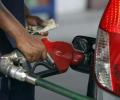
A looming global shortage of diesel in Europe presents India with more than one opportunity to profit from strong margins. A shortage of the fuel, a key contributor to inflation, has been exacerbated by the conflict in Ukraine, and western sanctions on Russian fuel supplies. The slowdown in natural gas supply means the West needs diesel to heat their homes this winter.

At 235,000 tonnes per annum, Pakistan is the third largest importer of tea in the world as it can't grow tea because of adverse climate conditions. India supplies just about a tenth of tea imported the neighbouring country

This is good news for the central government at a time when crude oil prices are rising.

The United Nations on Wednesday pared down India's growth forecast by 20 basis points to 5.8 per cent for 2023 calendar year, citing higher interest rates and risks of recession in the developed world weighing on investment and exports. "Economic growth in India is projected to moderate in 2023, with higher interest rates weighing on investment and slower global growth weakening exports," it said in its latest World Economic Situation and Prospects report. The report has projected global trade to contract 0.4 per cent and the world economy to grow at 1.9 per cent in 2023.
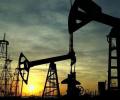
Soft oil prices are expected to persist in 2015 and will be accompanied by significant real income shifts from oil-exporting to oil-importing countries.

'We emphasise the importance of not basing investment decisions solely on electoral outcomes.' 'Instead, focusing on investing in high-quality businesses capable of prospering regardless of the political landscape is paramount.'
